I study law as people actually live it.
My work asks what constitutional and administrative law look like when they are read from the vernacular of particular places, from their own categories and moral vocabularies, rather than translated into the terms of a few Western systems.
Much of it begins in Indonesia. I am interested in what I call vernacular parochialism: the idea that legal concepts never travel unchanged, and that taking local understandings seriously may change how we think about law in general.
Questions I am working on
- i.
How do people make constitutional sense of a state without reading its constitution?
Folk constitutionalism and Pancasila. Related: Comparative Political Theory (2026) on negara kesatuan; a book in progress.
- ii.
Is administrative law a technique of legality, or a technology of justice?
Administrative justice as each polity lives it, beyond the developed West.
- iii.
What happens to law and religion when the Christian West is not the starting point?
An essay in progress.
- iv.
What does legal reform look like for a self that is relational?
With Beth Lyon, on farmworkers in West Java (Legal Pluralism and Critical Social Analysis, 2024).
- “Mistranslating Constitutional Law? Hukum Tata Negara, A Case for Doing Conceptual Analysis in the Vernacular.” International Journal of Constitutional Law, 2026. Free version
- “Negara Kesatuan, Different Kind of Unitary State: Theorizing a Folk Vision of the State.” Comparative Political Theory, 2026. Free version
- “Relational Self and Farmworker Law Reform: The Case of Indonesia” (with Beth Lyon). Legal Pluralism and Critical Social Analysis, 2024. Free version
- “Is There an Indonesian Constitutional Democracy?” Oxford University Comparative Law Forum, 2024. Open access
- “The Pancasila Delusion.” Journal of Contemporary Asia, 2016. Free version
- “National Ideology in International Law: The Case of Indonesia” (with Nandang Sutrisno). IJICL, 2026. Free version
- “State symbols.” Max Planck Encyclopedia of Comparative Constitutional Law, OUP.
- Hukum Internasional Kontemporer (with Jawahir Thontowi).
- “Reimagining Constitutional Theory.” Under review.
Teaching
I try to teach law as a humanistic enterprise.
Legal concepts never travel unchanged. In class I ask students to read the law closely, in the places and languages where it is lived, and to notice what is lost when it is carried into someone else’s terms. I learn as much from these conversations as they do, I suppose.
- University of Khorfakkan
- Legal Studies in English; Contract in Administrative Law
- Universitas Tarumanagara, Jakarta
- Comparative Constitutional Law; Comparative Administrative Law; Introduction to Legal Traditions of the World; Comparative Legal Theory
- Universitas Trisakti, Jakarta
- Comparative Constitutional Law; National Ideology and Law; Theories of the State
- ACICIS, 2021–2025
- Indonesian law for Australian law students
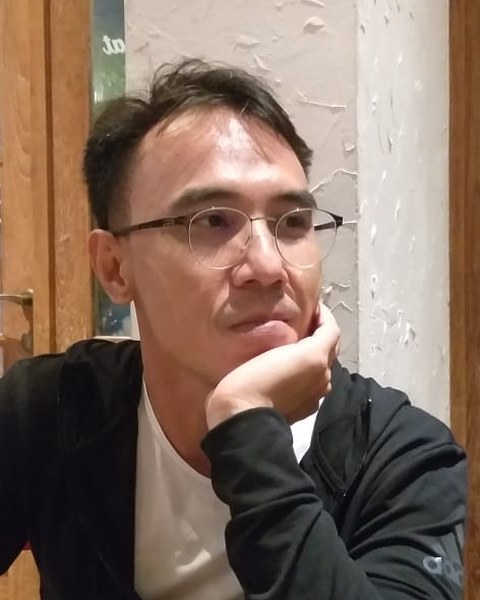
About
Founding editor of the Indonesian Journal of International & Comparative Law and founder of the Institute for Migrant Rights.
I studied in Yogyakarta, Ithaca and Montreal.